


The Montagnard
Pluralist Common Sense: Why DSA Gets Stuck on Lobbying
A critique of the debate on the class composition of DSA.
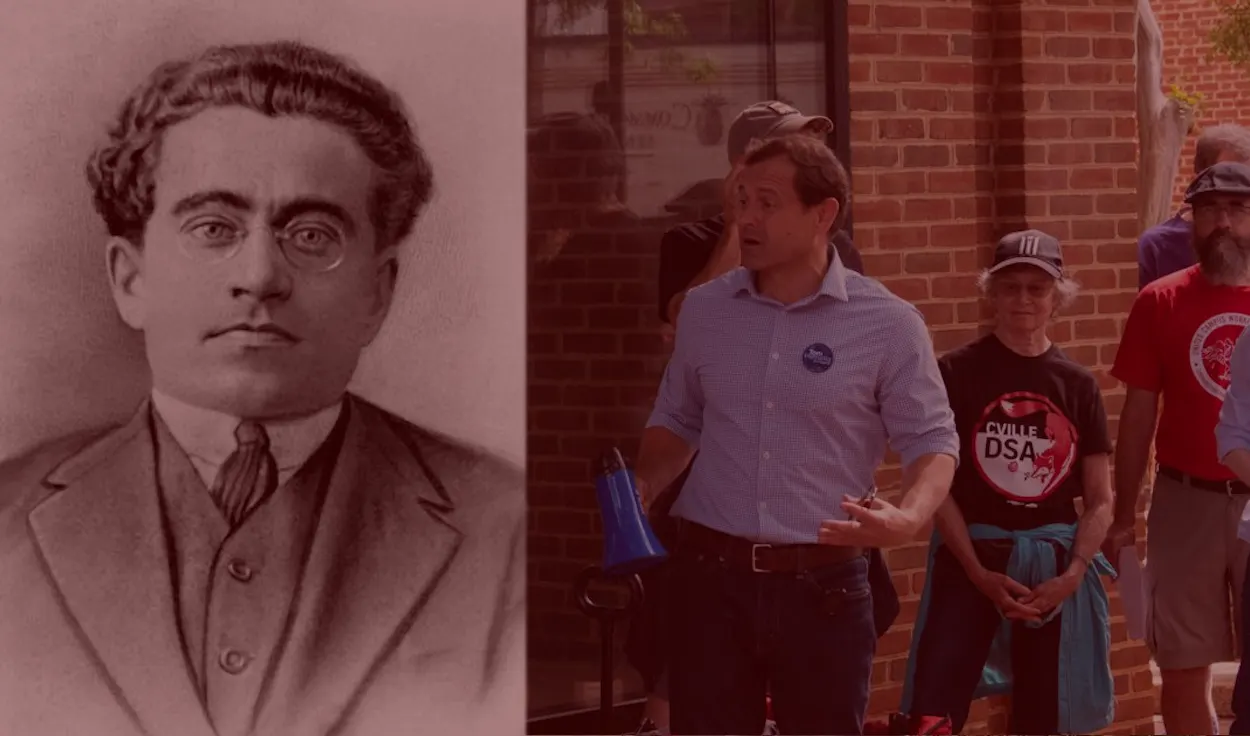
Much has been made of the class composition of the Democratic Socialists of America (DSA) and whether or not the organization is truly representative of the working class, which formed the traditional basis of the movement for socialism, or whether it actually represents the “Professional Managerial Class” or even the petty bourgeoisie. This discourse often devolves into discussions of the definitions of various classes and the specific demographic makeup of DSA, obfuscating more than clarifying. Rather than allowing for changes within the theory or practice of DSA, these class theories, at best, generate debates around the composition of its membership and, at worst, serve as the basis of personal accusations against members. Based on my experiences working in the Charlottesville DSA chapter, I propose that the ideology these accounts are reaching toward can best be described as a “pluralist common sense.” Drawing on the work of Antonio Gramsci, I theorize that the administrative mindset at play among some DSA members is not directly the product of their class status, but instead of their practical political experiences. Specifically, I am concerned with their interaction with the Democratic Party’s predominant mode of politics, in which interest groups lobby for a share of governmental resources. Despite the very different goals of socialist organizing, the common sense developed from this mode of politics often carries over to how DSA members approach their work, producing the often-decried impulse. However, unlike class-based accounts of the phenomenon, understanding it as a form of common sense suggests that it can be changed through changing how DSA members approach practice, namely by reorienting it towards the task of reconstituting proletarian civil society.
PMC and Petty Bourgeoisie
Concerns about the class composition of DSA have a long history in the revived (post-2016) organization, being arguably one of the defining issues of the pre-2023 period. The Class Unity Caucus, which left the organization in early 2023, positioned itself as fighting the predominance of the professional-managerial class (PMC). In the article announcing their formation in 2019, they wrote that DSA’s “lack of an organic connection to the working class will leave it vulnerable to capture by the interests and ideologies of the professional-managerial stratum,” citing the work of Barbara Ehrenreich, a long-time DSA member who coined the term to describe the basis of an emerging “middle class left” in the 1960s and 70s. Class Unity proposed that the PMC found their expression in DSA through the spread of an “identarian” ideology that conflicts with an authentic working-class politics. In response, Class Unity sought to combat identity politics with the assertion of working-class status in hopes of breaking the grip that the PMC supposedly had on many chapters. In hindsight, with Class Unity having exited the organization years ago, we can safely declare their attempt to be a failure.
Nevertheless, their impulse to criticize the class composition of DSA lives on and has perhaps revived in the past year, as represented by two recent articles. The first, “Was Lenin PMC? How Elite Theory doesn’t fit the movement for socialism” by Chris Cutrone of the Platypus Affiliated Society, aims to critique the pessimistic assumptions of PMC theory as applied by Class Unity and similar thinkers, but ends up affirming their analysis of the modern DSA as a PMC-dominated organization. The second article, “American Socialism becomes a mass movement” by David Passerine of the Australian Communist Unity, by contrast, argues that DSA and its associated movement is “a mass movement of the petty bourgeoisie.”
Cutrone’s article is divided into pieces which point in different directions. In the first part, Cutrone argues against the conception of the “professional managerial class” from the elite theoretical standpoint advocated by sociologist Musa al-Gharbi, with DSA and associated political campaigns as a means by which “symbolic capitalists,” who serve capital by managing the conditions for its reproduction, contest for political power against other factions of the capitalist class. While Cutrone concurs with the characterization of DSA as primarily PMC, he nevertheless sees the PMC not as capitalists but as intellectuals, and drawing on Lenin and Gramsci, he elaborates an account of how the workers’ movement for socialism can allow the PMC to stop being “state intellectuals,” as Gramsci termed those who served the reproduction of the ruling order, and become “organic intellectuals” in service of the socialist party. Thus, Cutrone suggests that a change in political practice could transform the ideological tendencies against which PMC theorists react.
However, in the second half of the piece, Cutrone turns to a very pessimistic account of the history of DSA from its origins in the New Left. While he sees the original formation of DSA as the product of the failure of the strategy of its founder, Michael Harrington, to reopen a space for socialist politics in the United States, Cutrone is much less sympathetic to the modern DSA. Instead, Cutrone sees DSA as ultimately representing merely a variety of progressive capitalist politics, with all socialist potential liquidated in the Bernie 2016 campaign and the entry into the Democratic Party. If anything, he sees the ideological commitments of DSA members as an obstacle to achieving their practical goals, even as it allows the organization to continue to exist. He writes, “ If the DSA were to be clear about their status as PMC progressive capitalists — as al-Gharbi advocates — seeking policy reforms in capitalism through the Democratic Party, they would lose their organizational raison d’être. But the latter is based on a lie — or at least a self-deception.” But even this is unsuccessful, since instead of changing the Democrats on a policy level, the main practical effects of the DSA electoral strategy are to test out new rhetoric for the Democrats and to provide a massive canvassing army for their campaigns, as they famously did for Zohran Mamdani’s mayoral run. Thus, despite Cutrone’s aspiration for a role for the PMC types he sees constituting DSA, he sees the organization itself as a dead-end. How DSA members could change from being progressive capitalists to organic intellectuals serving the working class remains unclear, leaving the essay ending on a deep pessimism.
Passerine’s article is more optimistic overall about the prospects for DSA, but his analysis of the organization’s class composition as petty-bourgeois is perhaps even more pessimistic than the PMC account. On the one hand, Passerine, unlike Cutrone, sees the recent growth of DSA as representing the revival of the socialist movement in the United States, and the release of the Workers Deserve More Program as “a qualitative leap for DSA’s politics.” On the other hand, Passerine reads the PMC, which he frames as downwardly mobile or stagnant professionals, as petty bourgeois rather than as a stratum of the working class. While he sees the relationship of DSA to the Democratic Party as somewhat more contradictory than Cutrone does, Passerine sees the involvement of DSA politicians such as Zohran Mamdani and Chris Rabb in the project of “‘taking over’ the Democratic Party” and their embrace of policies resembling a more aggressive progressive liberalism rather than a socialist politics as the product of the class character of DSA. DSA members are mostly petty bourgeois liberals disaffected with the insufficient opposition to Trump from Democratic Party leadership, much like the Tea Party Republicans were disaffected with Republican leadership during the Obama years. Like Cutrone, Passerine discusses the potential role intellectuals could serve in the socialist party, but provides even less indication of how such a relationship could be established, other than a vague gesture to the idea of programmatic unity. Instead, he bemoans DSA’s impotence, writing that “In an era where the workers’ movement remains moribund, merging it with socialism remains beyond the ability of the DSA.” Thus, while less cynical and more excited about the possibilities of DSA than Cutrone, ultimately Passerine also doubts the ability of the organization and its members to become the basis of a proletarian socialist organization.
Whatever the relative optimism or pessimism of these different accounts, all of the examples of PMC critiques of DSA share a basis that the composition of the organization’s membership causes its political orientation to be inadequate to socialist politics. Nevertheless, both the articles by Cutrone and Passerine suggest a role for the individuals that they consider to be PMC or petty bourgeois, specifically in their role as socialist intellectuals merging into the workers’ movement via a socialist party, even as the politics emerging from their class status serves as a formidable obstacle to the conditions for that merger to occur. Thus, despite Passerine’s disconnected appeal to programmatic unity, neither article provides a strategic intervention into DSA, even as that is the aspiration of both.
Charlottesville DSA
To evaluate the purchase of the PMC critique on DSA in practice, I turn to the recent experiences of my chapter, Charlottesville DSA. Specifically, I will be examining how the chapter made strategic decisions for the past two years, starting in Spring 2025.
To start with, the composition of the active membership of the chapter, like many chapters, is predominantly middle-class professionals, but leading members work in a wide variety of professions, including blue-collar workers. Service sector workers, while not entirely absent, are rather underrepresented. So far, this seems to accord with the PMC theory of DSA.
Since Spring 2025, the chapter has engaged in three major sustained activities as represented by three committees/working groups: Migrant Rights, Ecosocialist, and Legislative Priorities. The migrant rights committee’s activities are rather typical for organizing around that issue, most especially focused on a court watch program, though it originally spent much of its time lobbying the police chief to prevent cooperation with ICE. The Ecosocialist Committee and the Legislative Priorities working group, however, have a notable orientation towards lobbying government entities. This orientation is most evident with the Legislative Priorities Working Group, since its entire purpose was to lobby the state legislature about various pieces of legislation that came before it in the last session, most notably a failed bill to allow collective bargaining for public sector employees which was gutted in committee before being vetoed by Democratic Governor Abigail Spanberger. The scope of the Ecosocialist Committee is larger, but its activities nevertheless center around lobbying a variety of governmental institutions around the state against the construction of gas power plants and data centers.
It would be easy to attribute this orientation to lobbying governmental bodies as the product of the class position of the PMC. Just as Musa Al-Gharbi argues that the PMC manages, shapes, and facilitates the reproduction of capital in their public and private sector jobs, we might attribute the committees’ activity towards a similar tendency in politics. Instead of the management of capitalism in a conservative manner, we can imagine the DSA members wanting to shift that management in a more progressive but still capitalist direction, e.g., government support for renewable energy projects rather than gas plants. As a description of the practical results of these activities, this account is fair enough, especially for the Legislative Priorities Working Group. However, this account would miss what is happening within the committees themselves.
Despite, and perhaps because of, its orientation towards lobbying governmental bodies in a number of different counties, the Ecosocialist Committee has not been predominantly the preserve of the more professional members of the chapter, as the PMC critique of Cutrone and Passerine would predict. Instead, the committee has seen great success in mobilizing and even recruiting members in very rural and underserved towns in central Virginia, especially in Fluvanna County. The new members of the committee are far from being the stereotypical PMC, and are instead primarily recruited from the rural working class discontented with the negative effects of data center construction in their communities. Thus, while the orientation of the committee is very much towards the politics of administration, its composition does not accord with PMC theory.
Since the Ecosocialist Committee has been relatively successful at recruiting members of the working class, especially in areas not controlled by the Democratic Party, we might chalk up the strategic orientation of the chapter towards lobbying to being successful in partially overcoming the pessimistic predictions of Cutrone and Passerine, despite the failures of the Legislative Priorities Working Group. However, the Ecosocialist Committee only posed the underlying dynamic that the PMC critique takes as its object indirectly, i.e., the relationship between DSA and the progressive capitalist politics of the Democratic Party, while it was more directly posed in the strategic failure of the Legislative Priorities work.
For many years, Charlottesville DSA has engaged in very few attempts to organize the working class as such. The chapter did do canvassing around housing issues as recently as 2024, which put members in some level of contact with the broader working class of the city, but in general its orientation has not been towards the working class per se. Even in the work of the Ecosocialist committee, the orientation is towards organizing the broader community in those areas to lobby rather than organizing the workers as workers. Even within the city’s sparse labor environment, the chapter has barely engaged with existing unions and efforts.
However, as a part of the wave of interest in socialism that Passerine celebrates while critiquing, members of the Charlottesville chapter, myself included, participated in a push to create a new labor committee. The original design for the labor committee was to be quite broad, including not only activities like supporting existing unions in town and their efforts, but also to take an experimental character so as to learn from the workers of the Charlottesville area what their issues are and how organizing the workers’ movement here might help address them. Shortly after a member of the chapter proposed the committee, two simultaneous reactions emerged among many leading members of the chapter. First, no one voiced direct opposition to the chapter supporting the labor movement, and most members explicitly affirmed that socialist politics is oriented towards the working class. Secondly, many in the chapter expressed deep pessimism about the ability to get members to participate in labor work due to restrictive labor laws in Virginia. Without convincing the Virginia Democrats to support labor unions, and especially public-sector collective bargaining, they said little work could be done in central Virginia to organize the working class. Instead of allowing the formation of a Labor Committee or even a working group, chapter leadership instead convinced the original motivator of the proposal to create a “Labor Group” to hold a series of meetings across several months to investigate the possibility of and interest in the chapter doing work designed to help the working class organize themselves.
Despite the restricted start, the chapter’s labor work got off to a decent start by convincing the chapter to officially endorse an American Postal Workers Union rally organized by a local member, leading to a kerfuffle in which former Congressman Tom Periello tried to avoid being photographed with people in DSA shirts. This gesture was pretty limited politically, especially considering the rally’s primarily anti-Trumpist character, but it was the first real chapter mobilization for a labor issue in many years.
Unfortunately, DSA involvement in this rally is the only result of the labor group at the time of writing. The only other activity of the group has been a meeting held with several national DSA labor organizers. At this meeting, the national organizers encouraged the chapter to engage in investigative work to determine where in the Charlottesville area labor discontent might be developing organically and could be in need of assistance in translating into organizing. While the members who pushed for the formation of the labor group were optimistic about the prospects, many other members who attended the meeting expressed deep pessimism about the chapter’s ability to identify working-class discontents. Instead, as one member proposed, the chapter should lobby city council to create a commission into the working conditions of public sector employees to identify these issues. From an impulse to organize the working class on the basis of their discontents, the proposal became lobbying the local government so as to allow those discontents to be administered by the city. Rather than feeding into the creation of an independent proletarian politics, the tendency in the room was to look for ways to feed existing prospects back into progressive capitalist politics.
The most decisive moment in the brief history of labor work in Charlottesville DSA, however, was prompted by the creation of the labor group but did not occur inside of it. The Ecosocialist Committee, expanding beyond its primary focus on local governments, developed an alternative labor strategy. In collaboration with a local union, it developed a strategy in which the chapter would once again lobby the Democrats in the state legislature during the upcoming legislative session for the public-sector collective bargaining bill, advocating it as part of a package alongside a measure to repeal the tax exemption for data centers. The Ecosocialist Committee, without discussion with the labor group, also had a member propose steering that the chapter endorse a Labor Day rally by said union. Despite not making much sense from a strategic point of view, since it is proposing to trade on policy that Governor Spanberger opposes for a different policy she opposes, and completely undermining the purpose of the labor group in trying to develop a labor formation in the chapter, this strategy adopted by the Ecosocialist Committee reveals the logic underlying the chapter’s lobbying efforts. The logic of the strategy is that the chapter is picking an interest to represent (in this case, primarily university employees) and then lobbying for a share from the administration of resources, usually by Democratic Party-controlled governments. This mode of political behavior is known in the political science literature as pluralism, and will be explored as a historical category in the next section. While the chapter often lobbies against certain interests, such as owners of data centers or energy companies, the attempt to take up the positive interest in labor organizing starkly shows the underlying logic of lobbying efforts as an expression of the chapter conceiving itself (however unconsciously) as an interest group trying to get a share of resources. Thus, an impulse to organize the working class as an independent movement in the Charlottesville area is turned into its opposite: a strategy that subordinates the interests of the (public sector) workers to capitalist politics and ultimately to the whims of the Democratic Party.
First, I want to make it very clear that I do not think that anyone in the chapter is intentionally aiming to subordinate their politics to the Democratic Party. Quite the opposite, it is my experience that chapter members with a wide variety of beliefs express nothing but hostility and contempt for the Democrats and conceive of the chapter as a force that should be completely independent from them. Most of them share Passerine’s hope that the DSA can form the basis of an independent socialist party. Despite these commitments, though, we are left with a strategic orientation of interest group politics within the Democratic Party.
The PMC critique of DSA seems to initially do very well in the case of the Charlottesville chapter’s labor work. As predicted, the chapter turned towards what the critique would see as the class position of its membership, i.e., an interest in the management of the reproduction of capital rather than facilitating the struggle to overcome it. Additionally, in line with Cutrone and Passerine’s criticisms, the chapter suggests, at best, a policy change for the Democrats in the Virginia state government, but more likely, new messaging for internal factions opposed to the conservatism of Governor Spanberger. However, it fails to really grasp the dynamics happening in the chapter, especially with regards to the self-understanding of its members. The Ecosocialist Committee, as noted earlier, is not particularly dominated by professionals, nor is its understanding of its activity that it is trying to “take over” the Democrats, as both Cutrone and Passerine suggest the PMC/petty-bourgeois DSA activity understands its aim to be. Instead, the conception is that fighting for these reforms will both build the labor movement in Charlottesville (to the extent they think it is possible) and build the movement against data centers, both in the fight itself and in the expanded playing field that the reforms would bring to the public sector unions. Ignoring the political dynamics within the Virginia Democratic Party, this is not implausible, even if it is an inadequate approach to building independent politics. But why is the Ecosocialist Committee, and the chapter more broadly, ignoring the dynamics of capitalist politics to pursue this inadequate course anyway?
Reaching the limits of the PMC critique’s power, I propose to move beyond analysis of the class composition of DSA entirely. Rather than looking at the demographics of who makes up DSA chapters, I propose that the inherited political practices of contemporary politics are reproduced as common sense within chapters like Charlottesville DSA and the organization more broadly, to the detriment of achieving its professed goals. Specifically, I posit that this takes the form of pluralist common sense, in which the practices of interest group politics, which are predominant in both political parties in the present, inform what seems to be the natural course for political action to take, even if that course runs counter to the conscious goals of the chapter. While this form of common sense may be correlated with the experiences of those labeled the PMC, its roots are ultimately within chapter activity. Instead of needing to transform the composition of DSA or abandon the project entirely, the conscious transformation of the practices of the chapter and their more explicit orientation towards civil-social rather than primarily governmental struggles could allow the politics of the chapter to transform from their current orientation towards administration and the Democratic Party.
In the next two sections, I will develop an account of pluralism as a mode of politics, as well as the Marxist critique of it, before turning to Gramsci’s account of common sense as emerging from practice and the necessity of transforming civil society.
Pluralism
Pluralism originally referred to a theory in political science that sought to explain politics not in terms of classes or individual behavior but in terms of organized groups. Political scientist Theodore Lowi, the great internal critic of pluralism, described its theory as “(1) Groups, of which corporations are merely one type, possess power directly over a segment of society and also a share of control of the state. (2) Groups, rather than entrepreneurs and firms, are the dominant reality in modern life. (3) As long as even a small proportion of all interests remain strong and active, no unitary political class or ‘power elite’ will emerge” (Lowi 1979, p.34). While originally formulated as an explanatory theory of an increasingly administered modern society (though not understood in Marxist terms), Lowi argues that pluralism became the “public ideology” in the form of mid-century “interest-group liberalism” (Lowi 1979, p.50-51). With this transformation, Lowi argues the ideological content of the two major political parties and the old liberal-conservative debate became hollowed out, with the primary determinants of voting being about which interest groups are represented by which parties (Lowi 1979, p.42-44, 51). Thus, Lowi argues, politics is no longer, if it ever truly was, on the basis of the rational individual of bourgeois society nor the class conflict of capitalism, but instead the jockeying of variously defined interest groups for a share of administered resources.
While Lowi critiques interest group liberalism as paying insufficient concern to state legitimacy, he does so on the basis of the continued power of pluralism, which he sees as deepening in spite of and perhaps even through the resurgence of ideological conflict during the New Left. I raise this last element, though it is underdiscussed in Lowi’s work, to suggest the purchase that pluralism (or interest group liberalism) has on American politics is not limited to the period of the seeming end of ideology, as sociologist Daniel Bell described the 1950s, but also periods of great political tumult such as the 1960s and the present time (Bell 1960). In the period of the upsurge of not only partisan but also ideological polarization, as is represented by the surging membership and electoral success of DSA, we might expect pluralist conceptions to be rendered irrelevant, but Lowi’s work should warn us to continue to watch out for their continued operation.
Marxist theorists have long been critical of pluralist accounts of politics as obscuring. Motivated by a sense of inadequacy with pluralist political science, Ralph Miliband’s The State in Capitalist Society attacked its theory of the state as positing it as “the mirror which society holds up to itself” rather than as an instrument of class rule (Miliband 1969, p.3). While Miliband attacked the objective claims of pluralism, which have long since fallen into disfavor in even mainstream political science, the importance of pluralism remains as an ideology. Contemporaneously with Miliband, critical theorist Theodor Adorno wrote that “the word ‘pluralism’ lends support to the utopian belief that utopia already exists; it serves to mollify us [sociologists]” (Adorno 1968, p.113). By calling pluralism utopian, Adorno suggests that it persuades social scientists, even those as perceptive and historically oriented as Theodore Lowi, into the false belief that the problems diagnosed by Marxism have become overcome, and that the society based on free association has in fact been realized. On the contrary, Adorno argues, society remains unfree and contradictory, and it is the task of social scientists to reconstitute a dialectical theory of society (Adorno 1968). Thus, according to its Marxist critics, pluralism fails to live up to both its objective and subjective aspirations, both as an account of the state and politics on the one hand and as a political theory on the other.
Despite the power of these critiques, however, the case of Charlottesville DSA suggests the power of pluralism as a descriptive framework for political practice today. Particularly relevant is the orientation towards the chapter to labor work, and especially the proposed trade-off between taxes on data centers and public sector collective bargaining rights. Despite, and partially because of, DSA ideological commitments to merging their activity with the workers’ movement, the instinctual approach to organizing working-class people in Central Virginia has been towards fighting for an increased provision from the state government and for a share of political power within the state Democratic Party, even though the latter runs counter to the aspiration to create an independent socialist party. Despite the objective political inefficacy of this strategy and the general hostility towards organized labor by leading Democrats such as Governor Spanberger, the chapter nevertheless moves to act in a pluralist fashion. Thus, while pluralism seems to be debunked in theory, it nevertheless is operative in political practice.
While Miliband and Adorno are perceptive critics of pluralism, their discussions of it do not provide much help in explaining its continued practical purchase. Miliband sees pluralist theories as emerging as a Cold War alternative to class-based theories that were associated with the Eastern Bloc and as an ideology of affirmation of the existing working of Western “democracies” (Miliband 1969, p.4). Adorno, while less concerned with the Cold War dynamics, similarly sees pluralism as an ideology in which social scientists affirm the present as “utopia” (Adorno 1968, p.113). However, neither of these accounts gets beyond a critique of pluralism as an ideology of social scientists and examines its operation in the realm of practical politics. Instead, we must ultimately return to Lowi’s explication of pluralism in political practice as the starting point of a critical account of pluralism as manifested in the contemporary DSA. While keeping Adorno’s insights in mind, I turn to the work of Italian Marxist Antonio Gramsci to form a critical account of the persistence of pluralism and to provide a starting point for its practical overcoming in DSA.
Common Sense
One of the most understood concepts in the work of Antonio Gramsci is his concept of common sense. Gramsci rather obscurely defines common sense as the “folklore of philosophy” and describes it as absorbing various elements of science and philosophy, as well as “the conception of the world acritically absorbed from the various social environments in which the moral individuality of the average person is developed.” (Gramsci 1992, p.173; Gramsci 2008, p.333-334). Nevertheless, following the reading of Gramsci’s Prison Notebooks advanced by Sylus S, an account of common sense emerging from social practice seems the most persuasive reading of the text, especially considering Gramsci’s commitments to Leninism and Communist Party politics. Following that reading, it is Gramsci’s statement that common sense derives from the social environment, rather than just cultural or philosophical discourse, that is of importance. Gramsci puts these two elements into a dialectical formulation, emphasizing on the one hand the way in which common sense has historically been dominated by religion, but on the other hand, “‘Realistic, materialistic’ elements predominate” in it (Gramsci 2008, p.333). For Gramsci, the religious element is synthesized with what is derived from immediate social experience, “in mere direct perception,” rendering the latter unable to go beyond itself via critique, as occurs in post-Kantian philosophy. While Kant saw his philosophical work as drawing out what was already implicit in the practice of the average person, Gramsci argues that practice is no longer, if it ever was, philosophical, but also not merely superstitious, not merely “folklore.” Instead, in common sense, the masses have a partial digestion of their social practice. Nevertheless, Gramsci is quick to emphasize that common sense “changes continuously” under the influence of both philosophical thought and dynamic social practice (Gramsci 1992, p.173). Thus, common sense is a problem on both the level of theory and of practice.
While much of the literature on Gramsci is concerned with the theoretical, or more often specifically discursive or symbolic, side of the problem of common sense, Sylus S’s work on Gramsci suggests an extremely important role for the practical side, in the “acritically” absorbed social experiences. Sylus’s examples of this practical common-sense focus on one of the most basic activities in capitalist society: commuting to and from work. In dispersed areas, the commute is primarily atomized, an individual in their car alone driving to work. Even though an international division of labor is ultimately a precondition for this experience, the immediate perception is one of extreme individualism. It suggests that the very cooperation that makes the experience possible is impossible. Sylus contrasts this with residents of New York City, who share the subway and streets with members of the working class from all over the world. Even without critical engagement, it suggests that cooperation is already the basis of their existence. Sylus argues that these perceptions drive, in large part, the difference in voting patterns and policy preferences in different areas. Thus, Sylus suggests that the reshaping of common sense in practice is one of the great tasks of a socialist movement today.
Pluralist Common Sense
Gramsci’s concept of common sense as a phenomenon emerging from both theory and practice allows the persistence of pluralist politics, including within the Left, such as in Charlottesville DSA. The members who are focused on lobbying as the starting point for political action are not doing so because they are ideologically committed Democrats, nor because they are members of the PMC or the Petty Bourgeoisie, but because pluralism is their learned mode of political practice, and thus starting with lobbying seems common sensical to them. This orientation can be termed pluralist common sense, meaning that it takes the pluralist approach to politics as a given starting point for political action, rather than critically examining that basis.
Since this problem has dimensions in theory and practice, it is worth examining each in turn. I propose that the theoretical cause of pluralist common sense, at least in the context of DSA, is the relatively weaker cause. While undoubtedly many DSA members have some level of mainstream education in politics alongside the political education they may have received in leftist spaces, the inherited assumptions of pluralism within that education are mixed with further developments of political science. The power of pluralist theory is not, as it was in Adorno’s time, as an account of the present as utopia, but instead as an inertial element in liberal attempts to comprehend the political world. Surely this inheritance from the middle of the 20th century still exists in the popular political imagination as a “sedimentation,” as Gramsci put it, but not so powerful an element as to predominate.
Instead, it is the practical element of common sense, the social learning that Sylus emphasizes, that plays the predominant role in the formation of pluralist common sense on the Left. As Lowi emphasized nearly 50 years ago, even as the pluralist account of politics became more and more problematic as an account, the mode of political action that it described persisted. Even in the age of Trump and hyperpolarization, much of politics, especially on the state and local level, is practiced as interest group lobbying. While the Republican coalitional structures have broken down in the past decade, and are perhaps primarily being held together as a coalition of discontents led by Trump, the Democratic Party continues, in large part, to function as an interest-group aggregator. This character of the Democratic Party significantly predates the period of the dominance of pluralism (a fact which Lowi acknowledges in his discussion of it), especially in its form of urban ethnic machine politics, but took on its modern form after absorbing the new social movements that emerged in the 60s and 70s (a point Lowi interprets primarily in terms of policy, but is better understood as a failure of the Left) (Lowi 1979). The continued pluralist character of the Democratic Party, despite the radical changes in its composition throughout the 20th century, is best embodied in the slogan of the Congressional Black Caucus: “Black people have no permanent friends, no permanent enemies…just permanent interests.” Despite the more radical aspirations of some of its members, like Ron Dellums, this founding slogan is the monument to the persistence of pluralist political practice into the modern Democratic Party, a fact also borne out by the increasingly conservative role of the Congressional Black Caucus within the party. With the pluralist character of Democratic Party politics in mind, we can return to the example of Charlottesville DSA and examine how this persists despite their aspiration to break from the Democrats.
While sharing a disgust with the Democratic Party and its politicians like Governor Spanberger, DSA is nevertheless still practically engaged in the political life of that party. On a basic level, though, chapters like Charlottesville DSA primarily draw from a political milieu of Democrats who have become disaffected with the party and its politics. Of these people, the ones most likely to become highly activated members are those with previous political experiences within Democratic Party politics beyond just voting. Not coincidentally, these members with prior experience in the Democratic Party are more likely to be members who have more free time, meaning that they are more likely to come from higher income strata of the working class, i.e., the groups commonly labeled as the PMC. Nevertheless, the relative privilege of these members is not the cause, as posited by the PMC critique, but an enabling condition for the development of pluralist common sense among members through their increased ability to engage with politics. Thus, the common sense inherited from this previous practice remains, despite the conscious attempt to break from the Democrats. Furthermore, this pluralist common sense is often reinforced by people’s experiences in their chapters. Many of DSA’s most notable accomplishments, such as the New York Build Public Renewables Act favorably cited by Sylus in his essay, were the product of extensive collaboration with and pressure on Democratic politicians. The perceived importance of such efforts is much greater in smaller chapters with less developed electoral or labor projects, such as Charlottesville DSA. The inherited pluralist common sense, then, becomes self-reinforcing as chapters continue to adopt strategies based on their suppositions.
To return to the case of Charlottesville DSA labor work, then, the sedimentation of pluralist common sense is so deep that a superficially irrational strategy seems completely reasonable to many members. It becomes the default. As the product of practice, pluralist common sense thus takes the role of the unexamined theory of change for many members, even if they may also profess contradictory theories of change as well, and serves as a stubborn obstacle to breaking out of the self-reinforcing loop and to a change in practice. Thus, the political practice of the chapter, even as it seeks to engage one of the most basic tasks of developing an independent socialist movement and party, remains stuck in the practices of the Democratic Party from which it seeks to break.
This is not, however, to return to the pessimism of the PMC critics. Despite the stickiness of pluralist common sense, that the problem emerges from political practice and not from the composition of the membership suggests a way forward. By recognizing the existence of pluralist common sense within its own ranks, DSA can begin the process of overcoming it by consciously changing its political practice. Instead of orienting towards lobbying government entities, DSA members should carry through the original impulse of the Charlottesville DSA labor committee to reorient towards the rebuilding of an independent workers’ movement. As members gain new experiences in organizing, the strength of the old form of common sense should diminish, allowing DSA members to take up the role that Cutrone and Passerine aspire for them to be: the organic intellectuals of the workers’ movement for socialism.
Originally published in The Rose Garden.